


Picking the right Zoho Partner is one of those decisions that looks simple from the outside and turns out to have real consequences once you are six months in. The wrong partner can leave you with a system you do not understand, automations no one can maintain, and a sense that you paid for a product that never quite arrived. The right partner becomes a long-term resource that helps your business grow on a platform you actually own.
This guide gives you the questions that actually matter, the red flags that should stop you cold, and the green flags that signal a partner worth hiring. It is short on purpose. You should be able to read it in 10 minutes and walk away with a clear plan for your next discovery call.
Quick Answer
Shortlist three to five Zoho Partners with verified track records. Ask each one structured questions about experience, certifications, methodology, pricing, support, and team continuity. Audit their communication during the sales process. Request real client references and call them. Tier matters less than fit. The lowest bid is rarely the best deal. Communication quality during the sales process is the single best predictor of how the engagement will actually go.
Why Choosing the Right Zoho Partner Matters
A Zoho implementation is a long-term investment. The system you build now will likely run your business for the next 5 to 10 years. Sales pipelines, customer records, financial data, automations, integrations, and reporting all depend on decisions made during implementation. Those decisions are made by your partner, often without you noticing at the time.
Pick the wrong partner and you inherit problems that are expensive to unwind: a chart of accounts that does not match how you actually report, custom modules where renamed defaults would have worked, automations no one documented, integrations built on brittle workarounds, and a system only the partner knows how to maintain. We have rebuilt dozens of Zoho implementations from other partners over the years. The original cost is almost never the real cost.
The right partner does the opposite. They translate your business into a clean Zoho architecture, document every decision, train your team along the way, and leave you with a system you fully own.
How to Build Your Shortlist
Before you ask any questions, you need a shortlist of three to five partners worth talking to. Casting a wider net usually wastes time. Casting a narrower net leaves you with nothing to compare against.
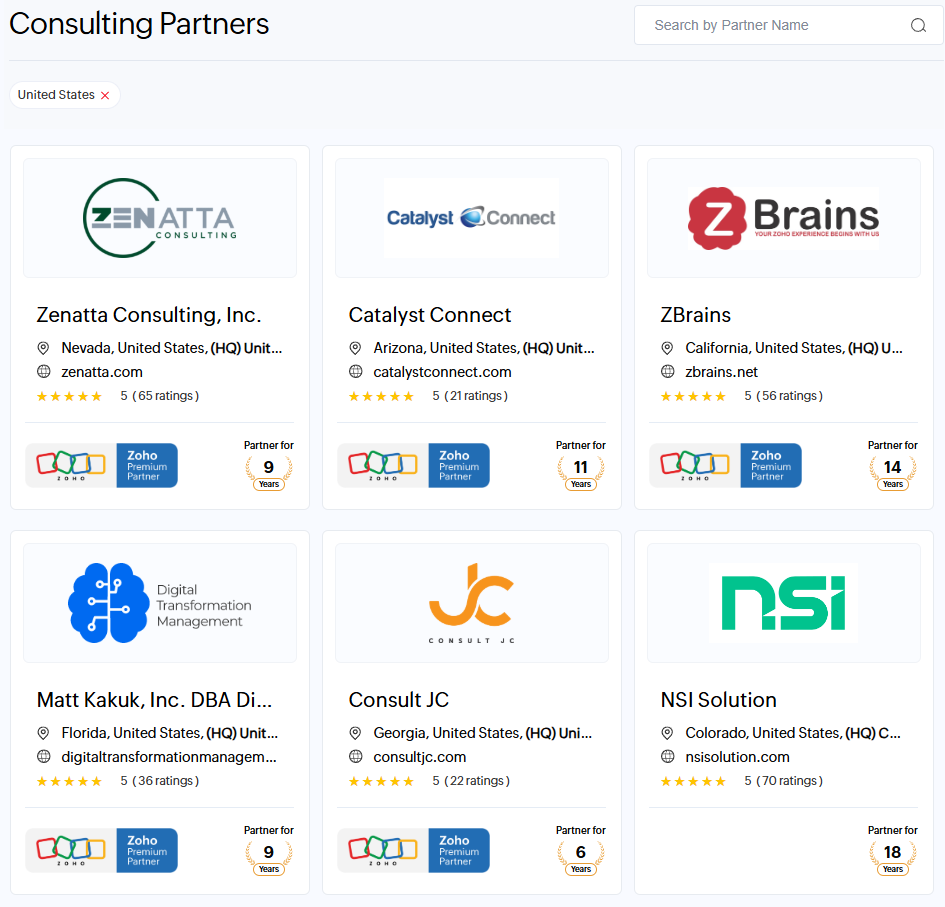
Start by looking at partner tier, regional alignment, and visible track record. Zoho organizes partners into three tiers (Authorized, Advanced, and Premium) based on revenue, certifications, tenure, and verified outcomes. Premium Partners have the most certifications and the broadest expertise. Advanced and Authorized Partners can still be excellent for the right project, especially if you want a more personal, boutique relationship.
Beyond the tier, look at case studies, customer reviews, and depth in the specific Zoho applications you need. A CRM-focused partner is a poor fit for a complex Books migration. A partner with no public case studies is a partner who either has no track record or is hiding it. Both should drop off your shortlist.
Finally, ask your network. If you know other businesses running Zoho, ask who they used and whether they would hire them again. Word-of-mouth is still one of the most reliable filters in this market.
The Questions That Actually Matter
Once you have your shortlist, schedule a discovery call with each candidate. Ask the same questions in roughly the same order so you can compare answers side-by-side. The point is not to interrogate the partner. It is to gather enough signal to make a confident decision.
How many Zoho implementations have you completed, and how many resemble my project?
Experience compounds. A partner who has done hundreds of implementations has seen edge cases you have not thought of yet and will spot anti-patterns in your requirements before they become problems. The follow-up question matters more than the headline number. A partner who has done 500 implementations but never in your industry is less useful than one who has done 50 in projects exactly like yours.
What certifications does the team that will work on my project hold?
Pay attention to the phrasing. Many partners advertise total firm-wide certifications, but the consultants assigned to your project may not be the same people. A good partner will name the people who will actually be on your account and share their certifications. A partner who deflects with “we’re certified in everything” is hiding something.
Can I see recent case studies from clients with similar scope?
Generic case studies are easy to write. Specific case studies that match your industry, size, or use case are evidence of real, repeatable expertise. Bonus points if the case studies have measurable outcomes like revenue impact, time saved, or errors reduced. A partner with zero public case studies is a warning sign.
What is your engagement and delivery methodology?
Different partners work in very different ways. Some go into a dark room for three months and hand back a finished system. Others work in weekly sprints with continuous client involvement. The methodology matters because it determines how much of your time the project will consume and how much control you have over the outcome. Make sure the answer matches how you actually want to work.
How is pricing structured, and what is and is not included?
Pricing structures vary wildly: fixed-bid projects, hourly retainers, sprint-based estimates, hybrid models. Each has trade-offs. The number itself matters less than what it includes, what it excludes, and how change orders are handled. A single low number with no scope breakdown and no change-order policy usually turns into a much higher final bill.
How do you handle ongoing support after implementation?
Implementation is the start, not the finish. Things break. Requirements evolve. New Zoho features come out. A good partner has a clear, structured ongoing support model with defined response times and retainer options. “We’re always here if you need us” without specifics usually means there is no real support process behind it.
How do you document the work you do?
This is the question most clients forget to ask, and it is the one that protects you the most. If a partner cannot explain how they document decisions, configurations, and customizations, you will end up dependent on them forever. Good documentation is how you own your own system. Look for partners who provide written specs, decision logs, or video walkthroughs of every meaningful build.
Can you integrate Zoho with our other systems?
Zoho rarely runs in isolation. You probably use QuickBooks, Shopify, Stripe, HubSpot, custom ERPs, or industry-specific tools. If integrations are part of your scope, ask about specific tools the partner has connected before and the technical approach they would take for yours. “We can integrate with anything” is technically true and practically useless.
Can you give me references from clients I can actually call?
Case studies are curated. References are real conversations. A partner willing to connect you to past clients is confident in their work. A partner who hesitates or deflects is not. Always ask, and always actually make the calls.
Red Flags That Should Stop You Cold
Some patterns are not just “less good.” They are warning signs that the engagement will almost certainly go badly.
Overpromising. “We can have you fully implemented in 30 days for $5,000.” If it sounds too good to be true, it is.
Skipping discovery. If a partner is ready to start building before they understand your processes, that is a problem. Good partners ask questions.
Slow communication during the sales process. If a form submission takes a week to get a response, if a proposal takes six weeks, if you cannot book a meeting on a real scheduler, those patterns will not improve once you are paying them. Roughly 95% of partner engagement problems trace back to communication.
No case studies or reviews. Every legitimate partner has either case studies, verified reviews, or both. A partner with zero public track record is hiding something or brand new.
Vague pricing. A partner who will not give you a rough ballpark in the first conversation is signaling that pricing will become a moving target later.
Pressure to sign quickly. “This pricing is only good through Friday.” That is sales pressure, not value. A real partner has a pipeline and is not desperate.
Guarantees they cannot possibly keep. No one can guarantee specific business outcomes from software. A partner who promises them is either inexperienced or dishonest.
Green Flags That Signal a Great Partner
The opposite is also true. Some signals tell you very quickly that you are dealing with a high-quality partner.
- They ask hard questions back. Good partners interrogate your requirements, push back on assumptions, and tell you when something you want is a bad idea.
- They have a structured discovery process. Free or paid, they have a clear method for understanding your business before they propose a solution.
- They tell you when Zoho is not the right answer. A partner willing to say “this should stay in Excel” or “you might want a different tool” is one you can trust.
- They are responsive without being pushy. Fast follow-ups, no cold pressure tactics.
- They show their work. Sample documentation, sandboxes, demos of past projects.
- They have a track record you can verify. Public case studies, third-party reviews, referenceable clients.
- They are honest about what they do not do. “We don’t do that deeply, but we can refer you to a partner who does.”
Questions a Good Zoho Partner Will Ask You
Evaluating a partner is a two-way street. Pay attention to what they ask during the discovery call. A partner who asks great questions is one who is going to do great work. A partner who jumps straight to selling without learning about your business is going to deliver a generic implementation.
Here are the questions a serious partner should be asking you:
- What does your business actually do, operationally?
- What systems are you running today, and what is and is not working?
- Who on your team will own the system after implementation?
- What are the top three problems you are hoping Zoho will solve?
- What does success look like 6 and 12 months after go-live?
- Have you tried to implement Zoho or another CRM before? What happened?
- What is your timeline, and what is driving it?
- What is your budget range, and what is included in that number?
- Who else is involved in this decision?
- What concerns do you have about working with a partner on this?
If a partner does not ask anything like these, they are selling, not consulting. Run.
Frequently Asked Questions
About the Selection Process
How do I choose the right Zoho Partner?
Shortlist three to five candidates with verified track records, ask each one the questions in this guide, score the answers, request and complete reference calls, then compare proposals side-by-side. Tier matters less than fit. Communication quality during the sales process predicts engagement quality.
How long should it take to choose a Zoho Partner?
Most businesses spend two to four weeks on partner selection. That covers initial research, three to five discovery calls, proposal reviews, reference checks, and final negotiation. Rushing this decision is a common cause of failed implementations.
Should I always choose a Zoho Premium Partner?
Not necessarily. Premium Partners have the most certifications and largest teams, but Advanced and Authorized Partners can be excellent for smaller projects. Match the tier to your project complexity.
Cost and Engagement
What is the biggest mistake people make when hiring a Zoho Partner?
Choosing on price alone. The lowest bid is rarely the best deal because partners who underprice usually pad scope, cut corners on discovery, or rotate junior staff onto projects.
Can I switch Zoho Partners mid-project?
Yes, and many businesses do when an engagement is not working. A good replacement partner starts with a system audit, identifies what to keep and what to rebuild, and migrates you onto a stable foundation without losing your data.
What should I have ready before the first discovery call?
A clear description of your business, a list of the systems you currently use, the top three problems you want Zoho to solve, who will own the system internally, and a rough budget range. Partners who get this information up front can give you much better answers in the first meeting.
Looking for a Zoho Partner Worth Calling?
Zenatta is a Premium Zoho Partner and the Zoho Americas Partner of the Year. We have delivered over 1,000 Zoho implementations since 2012. Book a free strategy session and put us through your evaluation process. We are happy to answer every question on this list.
Book a Free Strategy Session